It's not strictly necessary to know how a chord is constructed in order to use the library, but it can be very useful to have a minimum of knowledge on the subject. That's why I've decided to give you a basic explanation of chord construction so that you can make full use of each feature.
Music theory🔗
I don't intend to go into the minutiae of music theory, this topic is meant to provide you with inputs so that you can "create" your chords as you see fit.
Notes🔗
In Western music there are 7 natural notes that are well known even among
non-musicians.
They are: Do, Re, Mi, Fa, So, La and Ti.
To simplify reading/writing, these notes are cipher in a single letter.
| Nota | Cifra |
|---|---|
| La | A |
| Ti | B |
| Do | C |
| Re | D |
| Mi | E |
| Fa | F |
| So | G |
Tones and semitones🔗
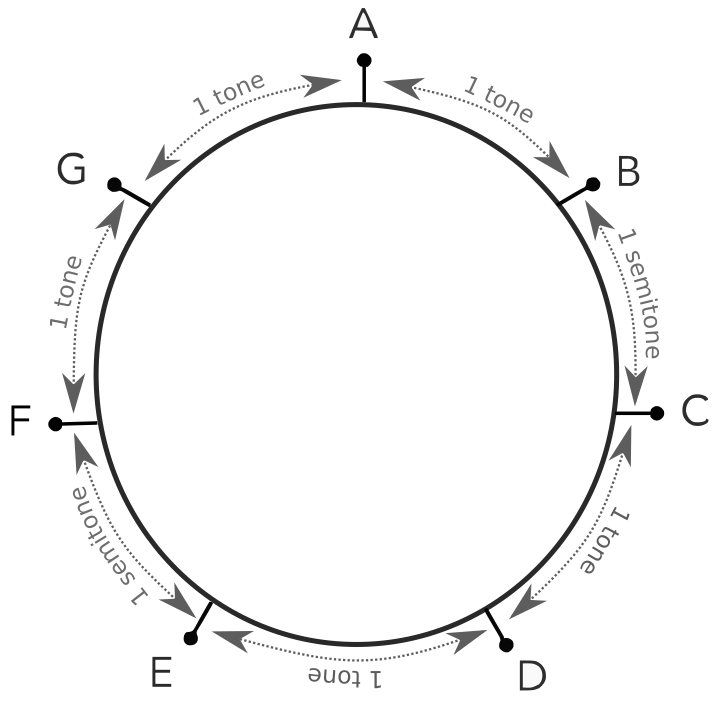
Between each of these notes we have defined intervals.
The unit that is used to measure these intervals is called a tone.
Between C and D we have the interval of 1 tone. From C to E is 2 tones.
Between E and F the interval is half a tone, also called a semitone.
These are all the intervals between natural notes:
Accidents - sharps (#) and flats (b)🔗
If you move a semitone from Do to Re, as the total interval to that note
is 1 tone, you'll hit something called an accident or alteration.
This accident transforms the note into another note and we use sharps (#)
and flats (b) to represent the change that has occurred.
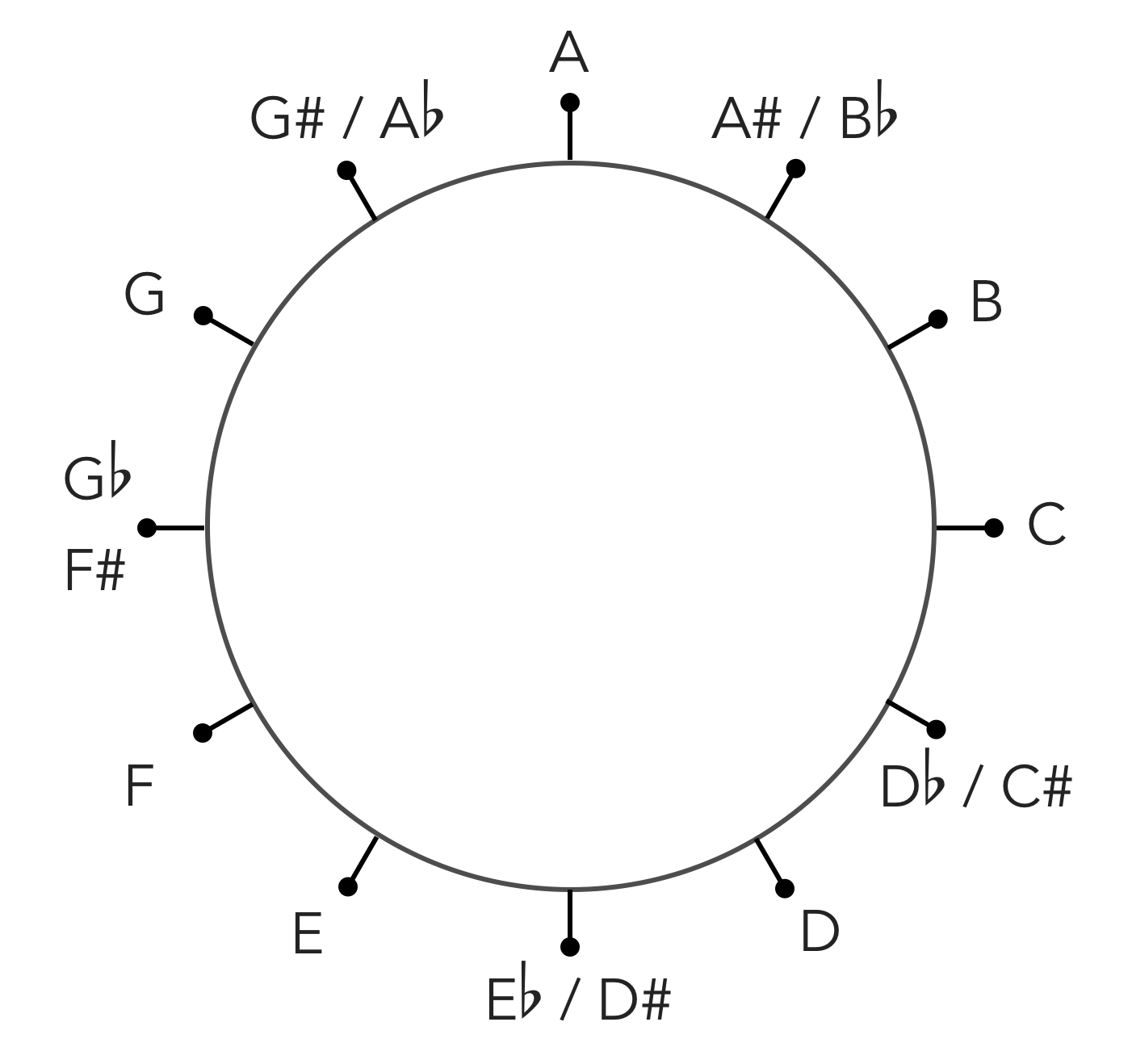
If you move forward a semitone, for example, from Re to Mi, the
change would be represented by Re sharp or D#.
However, if we went backwards, for example, from Mi to Re, that change
would be represented by Mi flat or Eb. D# and Eb are the same note,
what changes is the direction in which the alteration started.
Here you can see a better representation of these changes:
F## - Bbb (doublings)
For the record, it's worth mentioning doublings, which are double musical accidents that consist of raising or lowering the pitch by an interval of one tone.
| Accident | Natural |
|---|---|
F## |
G |
Bbb |
A |
These notes aren't used very often, it would depend on the interval in context (we'll talk about that later).
E# - Fb - B# - Cb
Just as there are equivalences between sharps and flats, for example D#
and Eb, the notes E#, Fb, B# and Cb also have their correspondences.
| Accident | Natural |
|---|---|
E# |
F |
Fb |
E |
B# |
C |
Cb |
B |
These notes aren't used very often, it would depend on the interval in context (we'll talk about that later).
But it's good to know that it's possible to use these notes and that they exist.
Intervals/Degrees🔗
The degrees represent how many intervals there are between one note and another.
For example, the note D is 1 tone away from the note C, which means that
D is the major second of C.
Below is a complete table of intervals with the note Do as an example.
| Do | Interval | Distance |
|---|---|---|
C |
root | no tone |
Db |
minor second | 1/2 tone |
D |
major second | 1 tone |
Eb |
minor third | 1 tone + 1 semitone |
E |
major third | 2 tones |
Fb |
diminished fourth | 1 tone + 2 semitones |
F |
perfect fourth | 2 tones + 1 semitone |
F# |
fourth augmented | 3 tones |
Gb |
diminished fifth | 2 tones + 2 semitones |
G |
perfect fifth | 3 tones + 1 semitone |
G# |
augmented fifth | 4 tones |
Ab |
minor sixth | 3 tones + 2 semitones |
A |
major sixth | 4 tones + 1 semitone |
Bbb |
diminished seventh | 3 tones + 3 semitones |
Bb |
minor seventh | 4 tons + 2 semitones |
B |
major seventh | 5 tones + 1/2 tone |
C |
octave | 5 tones + 2 semitones |
Db |
minor ninth | 6 tones + 1 semitone |
D |
ninth | 7 tones |
D# |
augmented ninth | 7 tones + 1 semitone |
Fb |
diminished eleventh | 8 tones |
F |
eleventh | 8 tones + 1 semitone |
F# |
augmented eleventh | 8 tones + 2 semitones |
Ab |
diminished thirteenth | 10 tones |
A |
thirteenth | 10 tones + 1 semitone |
A# |
augmented thirteenth | 10 tones + 2 semitones |
Chords🔗
A chord is made up of 3 notes or more. When the chord contains only 3 notes
it can be identified as a triad, when it has 4 or more notes it would be
identified as a tetrad.
The cipher of the chords uses the same ciphers as the notes with other information.
major (C)🔗
When there's only one note, for example, C, it means it's a major chord.
The major chord triad is made up of the degrees:
root, major third and perfect fifth.
minor (Cm)🔗
When there's a lowercase m after the letter, e.g. Cm, it's a minor chord.
The triad of the minor chord is made up of the degrees:
root, minor third and perfect fifth.
diminished (C⁰)🔗
The diminished chord is made up of: root, minor third, diminished fifth
and diminished seventh. Its notation is ⁰, for example C⁰, but it can also
be represented by dim, for example Cdim.
extension (Cm7/9b/11#)🔗
In cases where the notation contains numbers after the note, the notation
is representing an extension of the chord, for example, C9, which is the
addition of the ninth.
If the chord has the numeral 7, C7, for example, the minor seventh is added.
To add the major seventh, the notation to use is M or Maj, for example,
C7Maj or Cm7M.
The extension can contain b or - to represent that the degree of extension
will be diminished, for example, C11b or C11-, which is the addition of the
diminished eleventh.
Or it can contain #, or + to represent that the degree of extension will be
augmented, for example, C13# or C13+, which is the addition of the
augmented thirteenth.
These extensions can be used in major and minor chords, for example,
Cm6 (minor with a major sixth)
Cm9 (minor with a ninth), Cm9b or Cm9- (minor with a minor ninth),
Cm11b or Cm11- (minor with an augmented eleventh),
Cm13# or Cm13+ (minor with a diminished thirteenth).
More than one extension can be added to the chord to form a tetrad with more
than 4 notes. Example: C7/13+, C4/7/9.
Harmony🔗
Info
This topic is just to record your existence, I will not go into depth on the subject.
It is very broad and may not fit within the scope of the library.
Musical harmony🔗
Just for knowledge purposes, it is also worth mentioning the existence of the area of
musical harmony.
It deals with the way chords relate to each other in a progression.
Functional harmony🔗
Functional harmony concerns the sensations (emotions) that a chord will
have within the harmony.
These functions are qualified as rest, tension and resolution, based
on the sensation that it will produce in the listener.